
. Skip to main content
Vintage illustration of Knecht Ruprecht riding a horse beside a glowing Christmas tree, carrying a child and holding switches, in a snowy nighttime scene.

An early depiction of Knecht Ruprecht, St. Nicholas’s grim companion in German folklore. Known for punishing misbehavior, he often carries switches or a sack—and rides alongside Nicholas during holiday visits to judge children’s conduct.

How the Tradition of Santa Claus Has Evolved Over the Centuries

December 26, 2025

How the Tradition of Santa Claus Has Evolved Over the Centuries

From solemn saint to sleigh-riding icon—trace how Santa Claus has changed through history, blending folklore, faith, and festive tradition.

Share

Share On Facebook
Share On Twitter
Share On Pinterest
Share On LinkedIn
Email

Note: If you are short on time, watch the video and complete this See, Think, Wonder activity: What did you notice? What did the story make you think about? What would you want to learn more about?

This Christmas, many children welcomed a familiar visitor – a jolly man in a red suit and a sleigh full of gifts. But the bearded figure Americans recognize today as Santa Claus is a relatively modern creation, shaped over centuries by folklore, art and evolving tradition. Stephanie Sy reports. And a warning for parents and younger viewers: this story contains some spoilers about Santa Claus.

View the transcript of the story.

Remote video URL

Warm-Up Questions

  1. Who is Jerry Bowler, and what is his background?
  2. What historic figure is Santa Claus based on?
  3. When and Where did the bishop that Santa is based on live?
  4. How did Saint Nicholas become the patron saint of children?
  5. Why did stories surrounding Saint Nicholas transform into the Santa Claus stories we know today?

Essential Questions

Do you ever wonder about where other holiday traditions came from? If so, which ones?

Media literacy: How can you find out more about the stories and customs that accompany the holidays you celebrate?

News: Then & Now

The News: Then & Now section of the Daily News Lessons allows students to see connections between current and past news events. The activity provides historical context using primary sources from the Library of Congress.

Side-by-side comparison of a 1653 woodcut image of “Old Christmas” and a modern 2025 photo of Santa Claus in a parade sleigh, highlighting how holiday traditions have changed. Banner reads “News: Then & Now.” Logos from Teaching with Primary Sources and PBS NewsHour Classroom appear at the bottom.

Then

This segment explores the way stories about a bishop living in the Roman Empire somehow became a pop icon after many centuries. The segment also explores how Santa is imagined in different countries and cultures. The man in the red suit and fuzzy white beard may be more of an American tradition, with earlier European depictions lacking the familiar look.

Woodcut print from 1653 showing three men in conversation. On the left, a stern Puritan figure says, “Keep out, you come not here.” In the center, a bearded man dressed in long robes, representing “Old Christmas,” replies, “O Sir, I bring good cheere.” On the right, a younger man with a basket on his back welcomes him, saying, “Old Christmas welcome; do not fear.” The scene reflects tensions around holiday celebrations during England’s Puritan era. Text at bottom reads: “Imprinted at London for G. Horton, 1653.”
The 1653 cover art for "The Vindication of Christmas" courtesy of the Library of Congress

While the outfit didn't come together until popular representations in the 20th century, some other traditions about Santa's routine emerged earlier, such as the idea that he slid down chimneys to deliver presents.

A richly illustrated 19th-century print of Santa Claus seated inside a fireplace, holding toys and American flags. He has a long white beard, a broad-brimmed hat with a red plume, and wears fur-trimmed robes. Santa is surrounded by dolls, drums, tea sets, and other gifts. Above him sits a decorated Christmas tree on the mantel with faces, ornaments, and a miniature house, flanked by floral vases. The style reflects patriotic American themes and Victorian-era holiday traditions.
J. G. Chandler. "Santa Claus Presents his Compliments to All the Little Folks." Roxbury: S. A. Chandler, 1858. Rare Book and Special Collections Division. Courtesy of Library of Congress

Of course, other countries had other traditions, including "Krampus" in parts of northern Europe — a demonic figure who scares children just as Saint Nicholas or Father Christmas rewards them with presents and treats.

A set of three vintage European postcards featuring Krampus, a horned, devil-like figure from Alpine folklore known for punishing naughty children. In each postcard, Krampus is depicted with a long red tongue, goat horns, and carrying chains or switches. The first shows him riding a rocking horse with a child; the second shows him looming over frightened children with a chain; the third shows him driving a car with a child in the passenger seat and another in a basket on his back. The text “Gruss vom Krampus” (Greetings from Krampus) appears on each.
Three views of Krampus. Public domain images of vintage postcards. Courtesy of the Library of Congress

Today

In the United States, depictions of Santa are usually quite similar, partly due to popular songs, poems, films and more pop culture that describe him in detail.
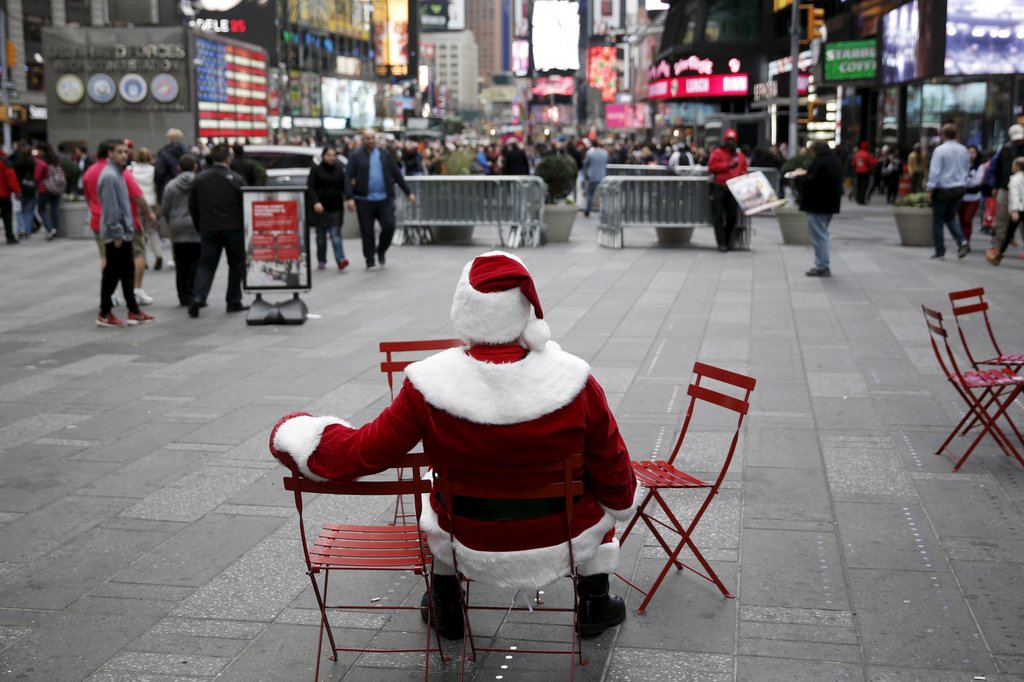
A person dressed as Santa Claus sits alone on a red folding chair in New York City’s Times Square, facing a busy pedestrian area. Surrounded by empty chairs and distant crowds, the Santa figure appears isolated amid the hustle of the city. Bright lights, storefronts, and digital billboards fill the background.
Santa Mark, a Santa Claus impersonator from Ansonia in Connecticut, sits in Times Square in the Manhattan borough of New York City, November 28, 2015. REUTERS/Andrew Kelly - RTX1W8YT

Still, there is no reason our idea of Santa Claus won't continue to evolve.

  • If you were to give Santa a new look to reflect our current culture, what would you change? Sketch your idea and share with the class.

Celebrate Winter Holidays

Winter traditions –whether it’s celebrating family, the new year or just a simple meal together – bring us together and remind us what we have in common instead of what divides us. Celebrate inclusivity and community this season and share these curated prek-12 winter holidays lessons and activities.

Subscribe to Our Newsletter

Want to see more stories like this one? Subscribe to the SML e-newsletter!

Republished with permission from PBS News Hour Classroom.

PBS News Hour Classroom
PBS News Hour Classroom helps teachers and students identify the who, what, where and why-it-matters of the major national and international news stories. The site combines the best of News Hour's reliable, trustworthy news program with lesson plans developed specifically for... See More
Advertisement

Post a comment

Log in or sign up to post a comment.