


What Can the President Do? Understanding Presidential Power in Venezuela and Greenland
How much power does the president really have in foreign policy?

Share
January 8, 2026
How much power does the president really have in foreign policy?
Share
When students follow news about the United States responding to events in other countries— through diplomacy, sanctions or military action—it can sound like the president is making all the decisions alone.
In reality, presidential power in foreign policy is shared, limited and shaped over time, often through precedent rather than clear rules.
The U.S. Constitution divides authority over international affairs between the president and Congress. The president’s role appears in Article II, Section 2, while Congress’ powers are outlined in Article I, Section 8. The president serves as commander in chief, meets with foreign leaders, recognizes foreign governments, and directs day-to-day foreign policy. Congress, meanwhile, controls funding, regulates trade and holds the formal power to declare war.
This division raises an important question for students and the public:
If power is shared, why does the president often appear to take the lead when the U.S. acts abroad?
Understanding this helps explain why many people ask how much power the president actually has and whether presidential power has expanded over time.
To answer those questions, students need to look beyond the Constitution itself. Throughout U.S. history, presidents have relied on past actions, historical doctrines and global events to justify decisions in foreign policy—even when the legal boundaries are not always clear.
That’s where historical ideas like the Monroe Doctrine come in.
Before moving on, ask students to consider:
To understand why presidents often take the lead in foreign policy, especially in the Americas, it helps to look at one of the earliest and most influential ideas in U.S. history: the Monroe Doctrine.
First announced in 1823, the Monroe Doctrine is a statement about how the U.S. viewed its place in the Western Hemisphere. At the time, many Latin American countries had recently gained independence from European empires. The U.S. government warned European powers not to attempt new colonization or interfere in the Americas.
In simple terms, the message was:
The Western Hemisphere is off limits to further European control, and the United States will oppose outside interference.
Although the Monroe Doctrine was not a law and did not come from Congress, it became a powerful guiding principle for U.S. foreign policy. Over time, presidents treated it as justification for taking action in Latin America—even when the Constitution did not clearly spell out what those actions should be.
The Monroe Doctrine was framed as a defensive policy. The U.S. was not claiming the right to control other countries, but it was asserting a special role in protecting the region from European influence.
However, as U.S. military and economic power grew, so did the interpretation of the doctrine.
By the late 1800s and early 1900s, presidents increasingly used the Monroe Doctrine to argue that instability in Latin America could justify U.S. involvement. This shift helped expand presidential power in foreign policy, especially when presidents acted quickly without waiting for Congress to weigh in.
For students, this raises an important question:
If the Monroe Doctrine started as a warning to Europe, how did it become a reason for U.S. intervention in Latin America?
That question became even more pressing in the early 20th century, when presidents began stretching the doctrine further.
In 1904, President Theodore Roosevelt added a new interpretation to the Monroe Doctrine, known as the Roosevelt Corollary.
The Roosevelt Corollary argued that the United States had the right to intervene in Latin American countries if instability, debt or conflict might invite European involvement. Rather than waiting for Europe to act, the U.S. would step in first.
This marked a major shift:
Together, these ideas helped justify a stronger presidential role in foreign policy decisions—especially in the Western Hemisphere.
Before turning to a modern example, ask students:
The Constitution is law. The Monroe Doctrine is an idea.
But over time, ideas can start to feel like rules.
Although the Monroe Doctrine was never passed by Congress or written into the Constitution, presidents treated it as guidance for how the U.S. should act in the Western Hemisphere. As more presidents relied on the doctrine, the idea gained power through repetition and precedent.
This helps explain how presidential authority in foreign policy can expand even without new laws.
Venezuela offers a clear example of how presidential power in foreign policy often operates in a gray area between constitutional authority, historical precedent, and political judgment.
In recent years, the U.S. has responded to events in Venezuela through sanctions, diplomatic pressure, and public statements about leadership and democracy. In many cases, these actions have been led by the president and the executive branch, sometimes with limited direct involvement from Congress.
The president can recognize a foreign government and impose sanctions under Article II, but Congress controls the money that makes those actions stick.
This raises a familiar question for students:
What gives the president the authority to act this way toward another country?
The answer is not always found in a single law or constitutional clause.
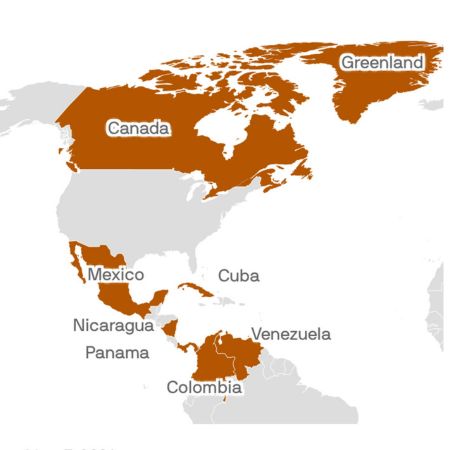
Presidents have often pointed to a mix of factors when responding to Venezuela, including:
While none of these automatically grant unlimited power, historical ideas like the Monroe Doctrine and Roosevelt Corollary have helped shape expectations that the U.S.—and especially the president—will take the lead in addressing crises in the region.
Because these doctrines emphasize U.S. responsibility in the Western Hemisphere, they are sometimes used to justify action in Latin America in ways that would be more controversial elsewhere.

This Share My Lesson resource from New York City teacher Sari Beth Rosenberg helps students analyze how presidential power and U.S. foreign policy toward Venezuela are portrayed in the media, using real headlines and reporting.
Looking at Venezuela also helps students ask a deeper comparative question:
Why might the United States act more directly in Venezuela but not take the same approach in countries like Turkey or places like Greenland?
This comparison highlights the limits of presidential power as much as its reach.
The Monroe Doctrine was explicitly focused on the Americas. Its logic does not easily apply to regions outside the Western Hemisphere, where U.S. involvement is shaped by different alliances, treaties and international norms. Even so, the habit of executive-led foreign policy can make it seem as though the president has similar authority everywhere.
In practice, context matters—history, geography and precedent all shape what actions seem acceptable or expected.
Ask students to consider:
By now, students may notice something important: Even though the Constitution divides foreign policy power between Congress and the president, the president often appears to be in charge when the U.S. responds to events overseas.
That tension is not a mistake. It is a long-standing feature of how U.S. government works in practice.
Presidential power becomes unclear when written rules do not fully explain real-world decisions. The Constitution sets broad expectations, but it does not answer every question about how foreign policy should be handled in moments of crisis.
On paper, foreign policy power is shared:
This division was meant to prevent any one branch from having too much control. But the Constitution does not spell out how these powers should interact in every situation—especially modern ones involving sanctions, international pressure, or diplomatic recognition.
The Constitution left this unresolved; it never explains:
In reality, presidents often act first.
Foreign policy situations can change quickly, and presidents are able to respond faster than Congress through executive actions, diplomatic decisions, or economic measures. Over time, these actions become accepted practice, even when Congress does not explicitly approve or block them.
One example of Congress attempting to set limits is the War Powers Resolution of 1973. This law allows the president to deploy U.S. troops for a limited period, generally up to 60 days, without formal congressional approval. Even so, debates continue over how effective this law is and how closely it has been followed.
This helps explain why people often ask:
How much power does the president really have in foreign policy?
The answer often depends less on clear legal limits and more on what past presidents have done—and what other branches have allowed.
Presidential power remains unclear for several reasons:
As a result, presidential power tends to expand gradually, shaped by precedent rather than formal changes to the Constitution.
For students, this explains why debates about presidential power resurface again and again, especially during moments of global tension.
Ask students to consider:
This uncertainty becomes even more visible when the U.S. looks beyond Latin America, including places like Greenland, for example.
Can you find another example where a U.S. president acted abroad without direct congressional approval? What reasons were given, and how was the decision received?
Recent discussions about Greenland have renewed questions about presidential power and U.S. interests beyond Latin America.
Greenland is a large Arctic island that is part of Denmark but has extensive self-government. The U.S. has long had a military presence there because of Greenland’s strategic location between North America and Europe, particularly for defense and monitoring activity in the Arctic.
U.S. interest in Greenland is not new. After World War II, the U.S. explored the possibility of purchasing the island, but Denmark rejected the idea. More recently, renewed attention to Greenland has raised questions about how far U.S. leaders can go when pursuing strategic goals abroad.
Unlike Venezuela, Greenland is not in Latin America and does not fall under the historical logic of the Monroe Doctrine. That difference makes Greenland a useful comparison.
It pushes students to ask whether presidential power works the same way everywhere, or whether geography, history and precedent still shape what presidents can realistically do in foreign policy.
This comparison also highlights a key question: When U.S. leaders emphasize strategic interests or national security, what limits exist on presidential action, especially when Congress is not directly involved?
Another important difference is that Greenland’s relationship with Denmark places it within the NATO alliance. Because Denmark is a NATO member, major changes involving Greenland would have implications for U.S. allies and existing security agreements.
This adds an additional layer of constraint. Even when presidents emphasize strategic interests or national security, alliances like NATO can limit how freely the U.S. can act on its own.
During a public discussion about U.S. interest in Greenland, Stephen Miller described how some policymakers view global power:
“We live in a world in which you can talk all you want about international niceties and everything else, but we live in a world, in the real world, that is governed by strength, that is governed by force, that is governed by power” Miller told Jake Tapper of CNN on Monday. “These are the iron laws of the world since the beginning of time.”
This perspective emphasizes power and strategic advantage rather than cooperation or formal agreements. It also raises important questions about how presidents explain or defend foreign policy decisions.
Ask students to consider:
Understanding presidential power is not just a history exercise. It helps students make sense of current events, headlines and debates about U.S. actions around the world.
When the United States responds to situations like Venezuela, questions about authority often resurface—not because the rules suddenly changed, but because the rules were never fully clear to begin with.
Presidents today do not start from scratch.
Their decisions are influenced by:
Over time, these ideas have helped expand what presidents are expected to do in foreign policy, even when Congress is not directly involved in every decision.
The Constitution divides foreign policy power on purpose. That division creates safeguards, but it also leaves room for disagreement.
As a result:
For students, this explains why there is rarely a single “correct” answer when discussing presidential authority in foreign affairs.
By the end of this discussion, students should understand that:
These questions encourage students to read the news more critically and to recognize how history continues to influence government action today.
To close, ask students to consider:
Find more resources on international politics and how they relate to your students with our free collection of preK-12 lesson plans and teaching resources.
Want to see more stories like this one? Subscribe to the SML e-newsletter!


